
 Anthony Durkin
Following the demise of the Monégasque F1 driver Charles Lecerc at his home Grand Prix in Monaco, the topic of brake failure arose.
Previously with Brembo, Leclerc chose to switch to the supplier used by teammate Lewis Hamilton, Carbone Industrie and will continue for the foreseeable future.
It also posed the question as to what is so different about the design and construction of Formula 1 brakes, compared to a modern road car?
F1 braking systems are among some of the most extreme mechanical technologies in global motor sport.
And the competition between the two major suppliers being the aforementioned Italian company Brembo and French company Carbone Industrie (CI).
Both brakes define how quickly modern F1 cars can decelerate from 335 km/h to a cornering speed of around 100 km/h in such a short distance.
Formula 1 cars can generate up to 5G of force during deceleration, a force that is so intense that drivers often describe heavy braking zones as feeling like they are literally “hitting a wall that moves.”
To achieve this end result, the eleven F1 teams must rely on key components to work time and time again during the race duration:
- Carbon–carbon discs and pads,
- Brake‑by‑wire systems,
- ERS‑K hybrid regeneration,
- Highly optimized brake ducts and cooling channels.

These systems must operate between 400°C and 1000°C to be effective, as well as maintaining the structural integrity under enormous loads, and deliver consistent pedal feel for the drivers who brake at the absolute limit.
Understandably ‘cold’ brakes are deemed as being of no use and must be brought up to temperature as soon as is practicable.
While based on marketing alone, Brembo is the more widely known brand, CI has long been a favourite among teams and drivers seeking a particular braking feel and thermal behaviour pattern.
Both supply carbon–carbon discs and pads, but their philosophies differ in meaningful ways.
The term carbon-carbon is defined as being the main components such as the brake discs and the brake pads that are both made from a carbon fibre composite, rather than metal or ceramic materials as commonly used elsewhere.
Now we can compare the two brands used in F1 for their unique product differences.
BREMBO
The dominant and largest supplier in F1, providing callipers and friction materials to most of the grid.
They are known for their lightweight construction, aggressive cooling, and sharp braking response.
SHOP THE LATEST SCUDERIA FERRARI RANGE BELOW- 20% selected collections with F1PACE
CARBONE INDUSTRIE (CI)
The smaller supplier of the two, being an industry specialist in carbon–carbon friction materials. CI discs and pads are prized for their stability, smooth modulation, and resistance to thermal degradation.
In looking at a technical comparison between the two:
Brake discs
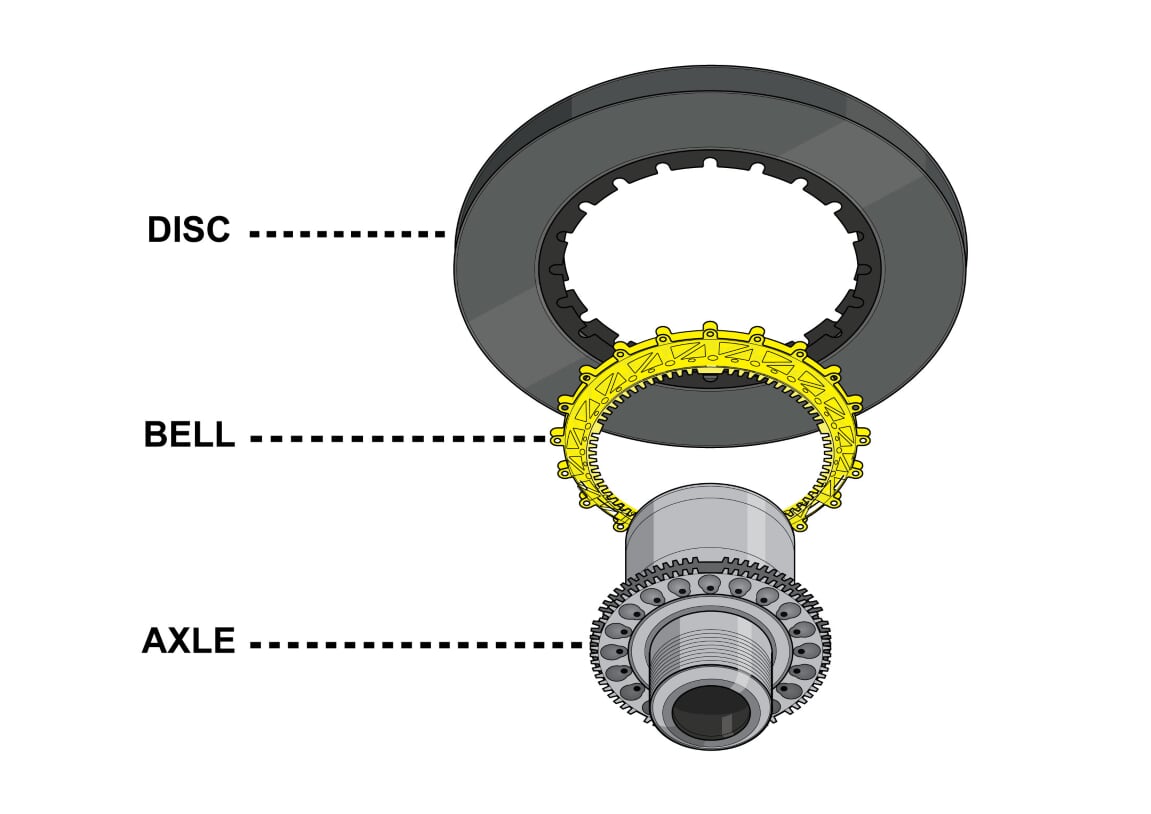
Brembo discs tend to feature high ventilation density (up to machined 1,500 holes) per disc, rapidly cool down, provide a strong feeling and initial bite, but are prone to temperature variance.
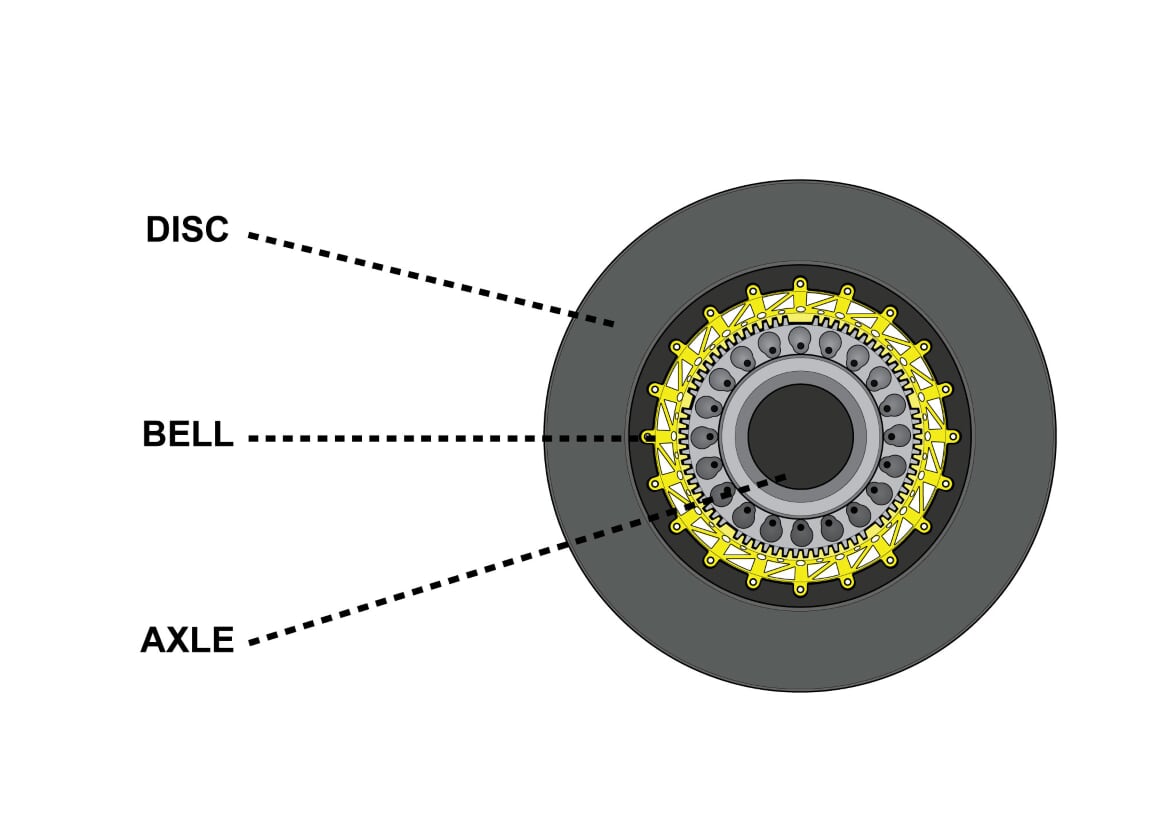
CI discs are known for larger ventilation channels, tend to have a more consistent band of temperature, renowned for being extremely resistant to the effects pf oxidation and delamination and offer smoother friction characteristics.
The driver can decide if they prefer Brembo that cools faster and bites hard; or CI brakes that are smooth and more stable.
 Brake pads
Brembo pads are made from high‑friction compounds, have a very aggressive initial response, felt through the foot and are also known to wear out faster under extreme heat from being used.
Brembo being favoured by late‑braking specialists.
The CI pads have a feeling of a more progressive friction curve, best wear characteristics and maintain performance up to 1000°C, offering a Smooth, predictable modulation that is ideal for long braking zones and tyre‑sensitive tracks.
Callipers
Whereas CI are focused on friction materials, Brembo is the leading supplier of callipers.
The Brembo callipers are extremely lightweight, very stiff, giving immediate pedal response and are favoured by teams chasing an aerodynamic packaging advantage.
Those teams that opt for using CI discs often still pair them with a set of Brembo callipers, creating hybrid systems tailored to their driver’s preference.
Of course, it is all good and well to rely on the brakes, but all that friction generates heat.
This is where the Brembo brakes are deemed as being faster cooling but are more sensitive to overheating and can oxidize if taken beyond the material’s thermal limits.

Compare this with the CI brakes which are slower to cool but offer thermal stability and great reliability and consistency in feel.
Now we as F1 fans well know, the Monaco street circuit is the most brake‑sensitive circuit on the calendar due to factors such as the lack of air flow, repeated and constant stop‑start braking and the minimal opportunities offered for clean air to help cool the brakes.

This was a leading cause as to Leclerc’s adventure into the barrier wall as he experienced a sudden front‑left brake issue, a moment where overheating caused instability under braking.
While not tied to a specific Brembo product failure, the incident highlighted that even the best braking systems operate on a consistent knife‑edge at circuits like the Circuit de Monaco.

As for Leclerc, he made the decision to switch from Brembo to CI as used by his teammate for the following race at the Circuit de Catalunya.
But it was apparent that coming to grips with the different feel of the brake pedal was a task that came at a cost during qualifying with him venturing off the circuit and into the wall.
A tough break for Charles!
TAKE THE F1 TRACK TO YOUR HOME WITH THE ULTIMATE RIGS FROM FANATEC


 Fraser Masefield


 Craig Scarborough