Craig Scarborough
Three times Formula One world champion Nelson Piquet once famously likened driving around Monaco to riding around your living room on a bicycle.
Okay, so some people’s living rooms are larger than others.
But the point he was trying to make was that of all the circuits on the F1 calendar, Monaco is the tightest, twistiest and most mentally demanding of the lot.
The slightest lapse in concentration can end with a car in the barriers. And it often does.

The race is so special, it is regarded as part of motorsport’s triple crown, along with the Indianapolis 500 and the 24 hours of Le Mans.
But unlike the Indianapolis 500, the challenge couldn’t be more different.
 78 laps covering 161.879 miles with around 62 gear changes a lap and over 4000 during the course of a race means that it’s an extreme examination of driver skill and concentration.
It’s also a severe examination of one of the most important parts of F1 tech – the gearbox.

A Formula 1 car can accelerate from 0-100knh in a little over two seconds and brake back to a standstill in half the time, vital for the stop start nature of the Monaco circuit.
It’s all made possible because of the ‘seamless’ eight-speed gearbox.
In a conventional manual gearbox, the drive is briefly disconnected when the driver selects a new gear by depressing the clutch.

With an F1 gearbox, because it is crucial that none of this drive is lost, a surprisingly simple mechanism ensures that when an upshift is made, drive is taken up on the next gear even as the previous gear is still engaged.
It does this without any lift of the throttle or reduction in fuel or Ignition. So that the engine is flat out all the way through the gearshift!
It means there is no loss of drive torque and precisely why the gearboxes in an F1 car are referred to as ‘seamless’.

These types of gearboxes can be worth three tenths of a second per lap, so every team has been running them since the early 2000s.
Unlike in your own car, unless you happen to be lucky enough to own a sports supercar, the F1 gears are operated by the driver by way of a paddle shift system behind the steering wheel.
When the driver flicks the gear paddle, it sends a signal to the ECU (Electronic Control Unit) which tells it that a gearshift is needed.
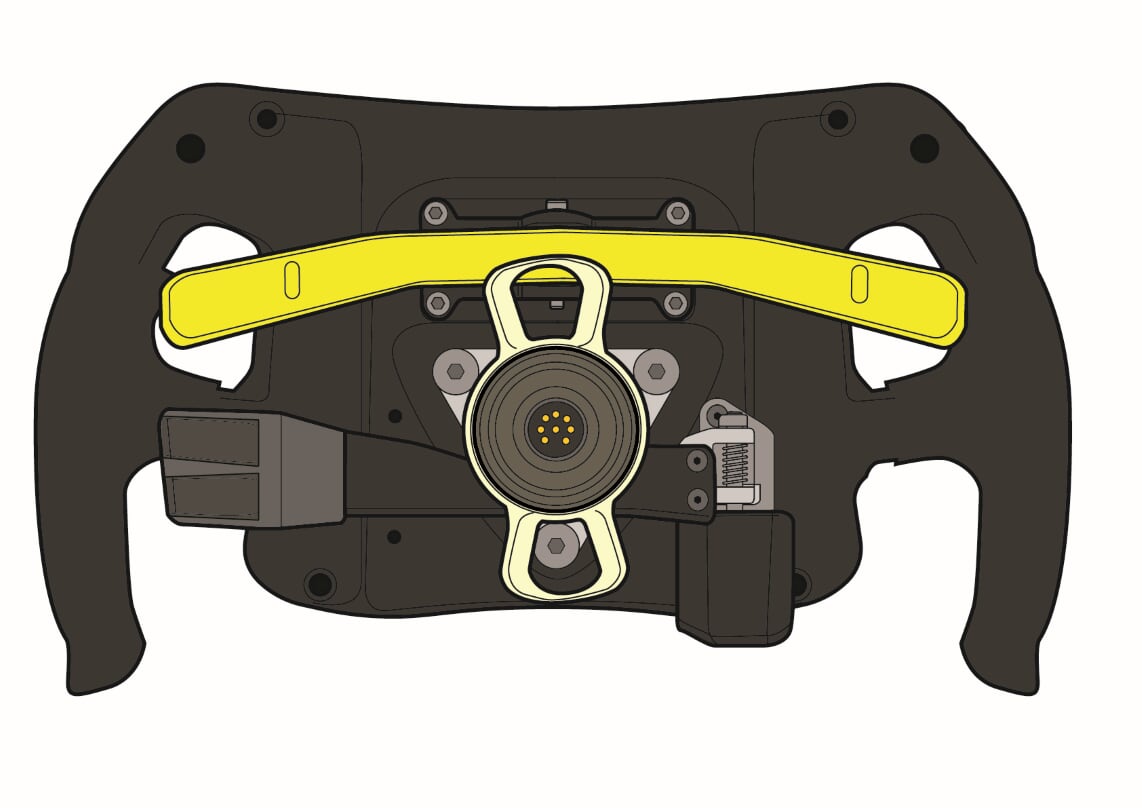
The unit knows whether an upshift or downshift is required and what gear the driver is currently in. The right paddle shifts up, the left down.
And with electronic control, a clutch is not needed to assist in the process, which can be completed in as little as seven thousandths of a second per change!
There are two gearshift paddles, one for upshifts and one for downshifts – although often one rocker paddle allows the driver to up or downshift with either paddle tip.
Paddle position, design and material varies by team and even driver. Even if there’s one rocker paddle, there will be more than one sensor, one for each action.
In the early days, these sensors were hall effect triggers, a sensor on the wheel and a magnet on the paddle would switch when in close proximity as and when the paddle is pulled.
Nowadays, it tends to be momentary microswitches inside the wheel pressed by the paddle as its pulled.
The paddles have heavy return springs and tiny rubber bump stops to control the paddle movement.
 The heavy springs are used to prevent inadvertent operation over bumps, while the bump stops and click of the microswitch are used to give a satisfying positive feedback through the driver’s fingers that a shift has been requested.
Constructed as one assembly, the paddles, pivots and springs are bolted to the back of the steering wheel.
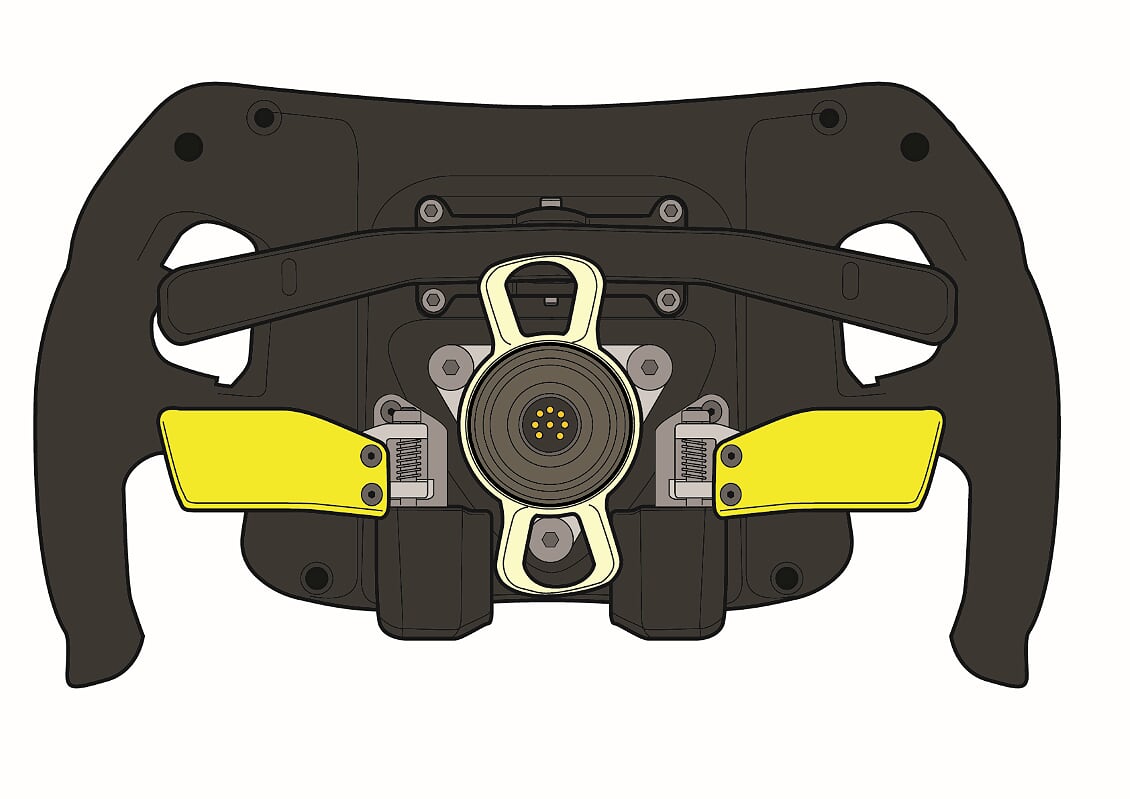
Like the shift paddles, the clutch paddles are quite stiffly spring to give enough resistance to modulate the fingertip control of the movement but not so much as to make it hard to control.
Paddle design varies enormously between teams and drivers, with either one long paddle or two smaller paddles. Paddles can be made in aluminium, carbon fibre and often with 3D printed finger grips.
Again, the entire assembly is bolted to the back of the steering wheel.
Like everything in Formula One, gearboxes don’t come cheap.
Teams can spend over $6 million on the development and production of the seven or eight gearboxes they will use over the course of a season.
Additional gearboxes will cost well over $300,000 each.

For us mere mortals, the closest we’re going to get to experiencing the unparalleled levels of acceleration and braking of an F1 car around Monaco’s tight confines is via the onboard cameras during the television coverage.
Or by purchasing one of the fantastic rigs from Fanatec.
Failing that, you could simply have a go at riding your bicycle around your own living room…
TAKE THE F1 TRACK TO YOUR HOME WITH THE ULTIMATE RIGS FROM FANATEC


 Fraser Masefield