
 Adam Cooper
In the first of s series of exclusive columns during the 2026 Formula One season, Adam Cooper looks at the key takeaways from the Miami GP weekend.
Everyone has accepted that the 2026 rules didn’t work
In the gap between Suzuka and Miami a huge effort went into analysing the impact of the 2026 rules over the first three races, with a series of meetings – including two involving the FIA and a small group of drivers.
The outcome was announced on April 20, with some tweaks or what the FIA called refinements to power unit deployment to be introduced for Miami.
Once they were trialled on track the consensus were that they went in the right direction, but did not represent a major change, with critic Max Verstappen calling them a “tickle”, and other drivers were also a little underwhelmed.
“I think honestly, it’s never easy to do a change during the season because as soon as you want to change something on the regulation, you are impacting the relative performance of the car,” said Ferrari boss Fred Vasseur.

“But I think for once that we were able to do, let’s say, good work, even if everybody wants to get more.
“At the end of the day, I think we did a step forward and I think it’s a good one.”
A formal review of the Miami changes involving the FIA, teams and power unit manufacturers held on May 8 concluded that the changes had done a good job and improved the racing, while acknowledging that there could be further tweaks.
More significantly the principle of bigger change for 2027 was agreed, essentially changing the balance of power between the ICE and the electrical contribution, via increased fuel flow to the former.
How that plays out in terms of fuel tank capacity, something that even at this stage will be hard to change for 2027, remains to be seen.

In the May 8 meeting it was pointed out by several team that they intend to carry over their chassis into 2027, something that has been a regular featured of the cost cap era.
And that means they cannot increase fuel tank size.
The easiest solution to that is to trim race lengths, with a figure of 4-5 laps mentioned in the meeting, although consumption varies by venue and some are less critical than others.
A more complicated alternative it to give teams an allowance in the cost cap to cover the cost of build new chassis.
All of this is still up for discussion.
V8s are returning in 2031 at the very latest
Momentum has been gathering behind a return to V8s for 2031 in recent months.
And speaking to journalists in Miami FIA president Mohammed Ben Sulayem made it crystal clear that it will be happening, whatever any other parties may prefer.
The big question now is can the change be anticipated to 2030?
That would require the support of the teams and PU manufacturers and would have to be agreed this year in order to stick the timeline required to develop the new engines.
The good news for Ben Sulayem is that the required support is building, with most people recognising that it will be the way to go.
“Long term, I think from a Mercedes standpoint, we are open to new engine regulations,” said Mercedes boss Toto Wolff.
“We love V8s, that has only great memories. And from our perspective, it’s a pure Mercedes engine. It revs high.
“And then how do we give it enough energy from the battery side to not lose connection to the real world?
“Because if we swing one hundred percent combustion, we might be looking a bit ridiculous in 2031 or 2030. So we need to consider that – make it simpler and make it a mega engine.”
Hamilton doesn’t trust the Ferrari simulator in Maranello
Like most teams Ferrari went to Miami with a big upgrade package – 11 items on the FIA declaration list, when others had seven or eight at the most.
It made a difference, and Leclerc led the race for a while.
But Lewis Hamilton was frustrated by how his setup was off at the start weekend and required a lot of work to hone, and thus his sprint was compromised.

He was happier by qualifying and then his race day was in any case spoiled by damage from early contact with Franco Colapinto.
“I’m going to have a different approach in the next race,” he said when I asked him about the sim.
“Because the way we’re preparing at the moment is it’s not helping, and so let’s see how that goes for the next race.
“Ultimately, it’s always correlation. We go on it, and then you get to the track, and the car feels different when you get to the track.”
SHOP THE OFFICIAL FERRARI LEWIS HAMILTON COLLECTION
Expanding on the theme he said: “You know I don’t like simulators in general, but I sit in the simulator every week on the build-up to the race, working on correlation constantly.
And you go on it, you prepare for the track, you drive it, and you get the car set up to a certain place, and then you come to the track, and that setup doesn’t work.
“And on the sprint weekend, for example, you’ve only got practice one, and you don’t really want to veer off from your setup too far, like with a big suspension change.
“And so you stay with it, and then you make a change going into qualifying, and then you’ve only got six laps to get on top of it.”
He made it clear that Leclerc had a better setup from the start.
 “In an ideal world, I should have started where Charles was at the beginning of the weekend in P1, and I think we would have just had a stronger weekend from now.
“So I’m not going to go on the simulator between now and the next race.
“I’ll still go and hold meetings at the factory, but back away from it for a little bit and see. When we went to China, had the best weekend without the sim!”
SHOP THE OFFICIAL F1 STORE FERRARI RANGE – CLICK BELOW
McLaren upgrades paid off – and there’s more to come in Canada
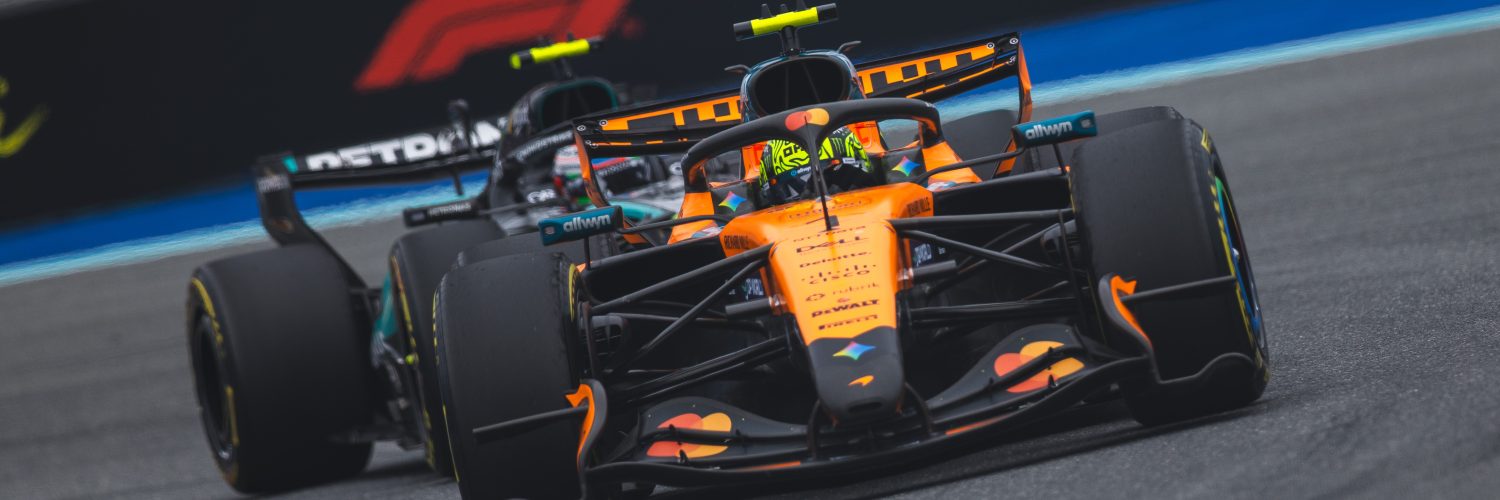
McLaren brought a sizeable upgrade package to Miami, including a new rear wing and floor, revised coke/engine cover and corner “furniture” front and rear, and updated sidepod inlet and cooling louvres.
As has been the case with the team in recent years, everything seemed to work.
Lando Norris led the race, and had he not lost too much time around the pit stop, he would not have been undercut by Kimi Antonelli.

Despite the disaster of two non-starts for Oscar Piastri and one for Norris, the team has scored well, and is still very much in the frame.
Nevertheless team boss Andrea Stella remains cautious and realistic.
“I think if we now start to consider championships, the end of the season, then I think we need to be a bit careful,” said the Italian.
“Because we are just at fourth race. We have just delivered our first upgrade. We are in Miami, and McLaren looks like traditionally has done very well in Miami. It could be that the way we develop our cars kind of suits this circuit.
“So we will have to see more, but at the same time, right? Because it’s only the fourth race, and we have scored a good chunk of points, even compared to Mercedes, and we know that we can further develop our car.
“We have said already before Miami that the championship is not a sign-off.
“So our logic is to look at the long term, try and defend the championship, but as soon as we say that, we come back in the present, because there’s really not much point in thinking so far forward.”

There’s another step for Montreal, which Stella implied will be complimentary to what we’ve already seen, and thus work as a package.
“We feel extremely satisfied with the weekend, very encouraged,” he said. “Not only because in a single weekend, we scored more points than the three previous races, but also because of the trend that we have established.
“We know that we have some more upgrades coming, which are kind of coming from the same group, so we are optimistic that they may allow us to take some further steps forward.”
SHOP THE LANDO NORRIS MCLAREN F1 CHAMPION RANGE HERE
Williams is making progress – and the weight is coming down
One of the biggest steps of any team in Miami was made by Williams, with the team going from a no-man’s land behind the main midfield and ahead of Cadillac and Aston Martin to finishing P9 and P10 in the race.
In doing so the team jumped VCARB, Haas and Audi.

That has to be qualified by the fact that not all of those teams fully optimised their own weekends.
Nevertheless Williams has made progress after some hard work in the spring break, especially on weight – the biggest Achilles Heel of the FW48.
“A really messy winter and the break gave us an opportunity to reset, take a breath, catch up, form a plan for not just Miami,” said team boss James Vowles.
“We brought upgrades here, but really what we’re doing now across everywhere up until the end of the season to put ourselves back into a sensible position, fundamentally.

“I am proud of the work that the team did. Every area was basically working at maximum capacity and that’s despite a difficult winter where people were putting in big, big hours.
“However, the gap is so large from where we are to the front that I’m sure we’ve made a small step into that, but it is a small step, and we need to keep doing that across the number of races in the future in order to make a tangible difference.”
Significantly the break allowed the team to identify how to nots just get down to the weight limit but below it.

Only 2kgs was removed for Miami but the rest will go as revised parts come through the system, and the originals have done their service – in a cost cap world every manufactured bit counts.
“All the weight is removed from the car, plus,” said Vowles. “It’s not delivered yet, but the engineering work is complete, plus another 10 kilos on top of that.
“That’s a sensible step. So here we’ve had an aero update and exhaust.
“It’s a tiny little sliver for weight saving but it’s still good to see that across the board we have about 40, 50 performance projects.
“And when they come, [we hope] that they do deliver the performance we’re expecting.”
TAKE THE F1 TRACK TO YOUR HOME WITH THE ULTIMATE RIGS FROM FANATEC


 Fraser Masefield
 Craig Scarborough