Craig Scarborough
In the second of our-pre-season car-by-car reviews, Motorsport.tech looks at three of the less fancied teams as the cars emerge from testing for the first Grand Prix of the 2026 season.
Haas Ferrari VF-26
Continuing their long listed-parts association with partner Ferrari, Haas are able to focus their resources wholly on aero and the core chassis structure.
As a result, they tend to come out of the gates running, sometimes with a fast car and occasionally with a more difficult one.
Their in-season progress is often poor, although 2025 was the first season where the teams’ usual traits were finally being rewritten.

This a result of the influence of Team Principals Ayao Komatsu, with his strong technical background and the partnership with Toyota in addition to Ferrari.
Toyota may not have been in F1 since 2009, but their Cologne operation has not stayed still, with several WEC titles and a constant increase in facilities and know how.
This appears to be working with Haas to understand how they operate and improve the car through the season.
Their VF-26 is like its predecessors the car is conventional and effective. Little stands out on the car, its mechanical parts are from Ferrari, so the suspension, steering, electronics and powertrain are lifted directly from the SF-26.
Leaving just aerodynamics to the team, the nose is low and rounded, with the front wing bearing some unique endplates.

In particular the large strake and then the footplate with a distant “r” shape to the scrolled edge. Cooling has to be the design of the team and not Ferrari, as radiators are considered bodywork.
So, Haas run a larger roll hoop inlet with a centreline radiator package mounted behind the engine.
Although the sidepods do not appear to be correspondingly smaller than Ferrari’s, taking a familiar bulkier shape, with a recessed waterslide along the top surface and a moderate undercut below.
Cooling outlet area is largely from openings in the sidepod top and engine cover, leading to a smallish coke bottle exit.
By running the entire Ferrari powertrain including the gearbox, gearbox case and rear suspension, it’s possible Haas could copy the Ferrari exhaust blown flap. But currently the rear end is entirely conventional.

Now in their tenth year, Haas have yet to step away from the listed parts approach or exploit it in a way that allows them to really develop their aero.
The partnership with Toyota suggests that perhaps they are now starting to diverge from their past, whether that remains as an independent Haas or a there becomes a bigger Toyota influence.
For 2026 a midfield position is inevitable, but perhaps there is more optimism they can fight toward the front of it.
Williams Mercedes FW48
There can be few teams that retain the respect Williams has earned over its time in F1.
However, the slide that started many years ago still appears to be blighting the team’s current progress.
With new Team principal James Vowles taking the team in a more certain direction last year, the winter showed that Williams Grand Prix Engineering, as it is formally known, still lacks something on the actual engineering side.

The only team to miss the entire Barcelona Shakedown week, not for the first time, a Williams was late for pre-season testing and the delay has certainly shown that some weaknesses still exist in the operation.
Last year a lot of emphasis was placed on the early switch to 2026 car development and the general optimism around the team suggested that a jump in 2026 could be the reward.
Looking at the test spec FW48, its not clear if the brief has been met. The car looks conventional, even bulky, although some of this could be explained by aerodynamic philosophies.
The nose sits low and also forms a chin that follows the curve of the wing, the endplates are curved and sport both a unique flag shaped strake and outwash vane.
Most teams have incorporated a single front flap adjuster into the nose, Williams retains two separate adjusters, one for each flap.
New for this year is an extreme front suspension inclination, the top wishbone angled radically such that the rear upper leg sits almost on the bottom edge of the monocoque.
The lower wishbone therefore is less splayed to create the space for the upper wishbone.
Interestingly Williams is the only team I observed to have tested different front wheel specifications.
There have been both the Red Bull style flat wheel and a more conventional spoked wheel tried during the Bahrain tests.
Behind these quite simple wakeboards are fitted, with the vertical leading board and a floor level slot on the section behind.
But it’s the sidepods that have drawn much of the attention. In a season where the trend has been for extreme undercut or slimmed sidepods, Williams appear oversized.

Seeing underneath the bodywork, it’s clear there’s no bulky cooling package and space under the radiator’s ducts could allow more undercut to be exploited.
Either Williams have opted for a conservative start to the year, with more than adequate cooling, which will come at the expense of performance.
Or, the bulky shape isn’t cooling related, but their philosophy for controlling the airflow around the car, most likely an attempt to keep the front tyre wake away from the central bodywork.

There’s little to observe on the FW48 that suggests their recovery is imminent. Testing proved them to be towards the back of the field on pace, and that in a year with two ‘rookie’ teams.
At least it was reassuringly reliable, with a mid-table finish on total laps. So, the team have a long season ahead of them to develop the car and continue their recovery.
SHOP THE WILLIAMSF1 RANGE:
FREE SHIPPING ON ORDERS OVER £35 WITH CODE FREESHIP
Cadillac Ferrari MAC-26
It’s been a fraught, on-off run into their F1 debut for the Cadillac team, formally known as Andretti.
But the foundations laid as Andretti have been paying off, with an experienced and prudent technical team.
As with Haas, Cadillac are running the Ferrari powertrain, but the comparison ends there. The team are designing as much of the car as is practical for year 1.

For example, the gearbox is Ferrari’s but the outer carbon fibre casing that dictates suspension and aero is Cadillac’s own.
While the steering wheel is a refaced version of the commercially available Motion-Applied wheel.
Everything is being addressed at the right pace, so the car might appear conservative, but the details suggest an ambitious aero programme underlying it.
Some decisions would have had to been made early to keep the entire programme on track. So the sign off for the monocoque and front suspension would have been amongst the first.
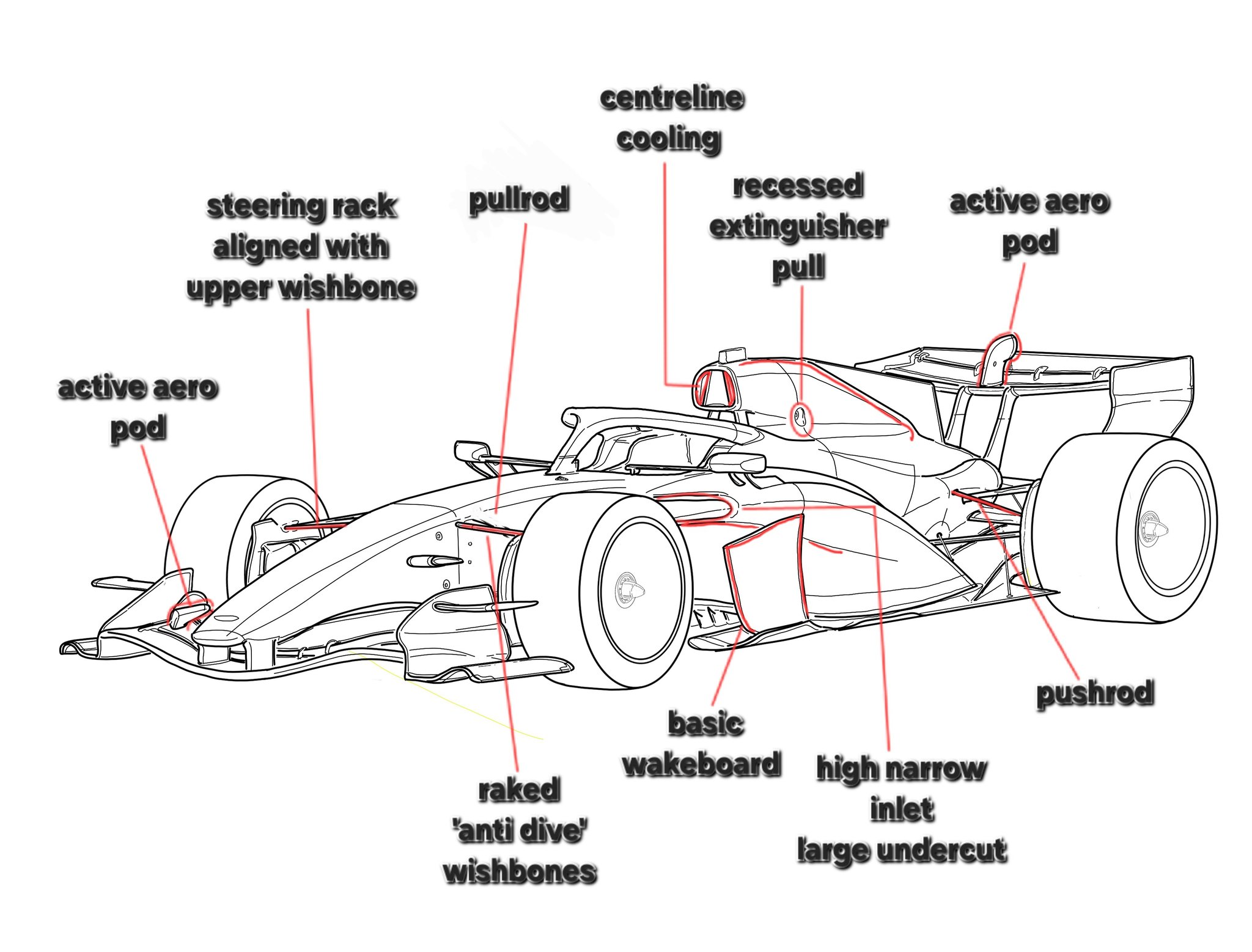
The car has ended up with some extreme inclination in the front wishbone geometry, but with an unusual high steering rack position, placing it in line with the top wishbone.
Also, the springs and dampers are operated by Pull rods in contrast to the reversion by most teams to pushrod.
It’s interesting that the team run AP Racing brake calipers, while AP are part of the Brembo group who supply the rest of the grid, it seems at odds the Brembo who supply calipers for the company’s sportier models.
Cadillac run BBS spoked wheels, but with a carbon fibre inner blanking disc, to keep them legal by blocking pass through airflow.
Wakeboards are similar to McLaren, in that the slots are made at floor level for airflow expansion from under the floor.
Then the sidepods are relatively simple downwash design with the front undercut ending early to create a front pressure zone that loads the front floor edge and keeps the front tyre wake away from the central bodywork.
Nothing has been seen of the inner cooling package, the but the heat vents from a louver panel on the side of the engine cover and a coke bottle exit.
As mentioned above the rear suspension is a pushrod set up, with conventional wishbone geometry, this mounting to the Cadillac Rear carbon casing, which houses the Ferrari gearbox cassette inside.

Above this the rear wing is unusual in that it opens DRS style, but has a very long chord middle flap, that lifts with the shorter more cambered rear flap.
It’s not clear what Cadillac are finding with this unusual solution, most teams play with this area either for increased drag reduction or a quicker return to full downforce from ‘SLM’ once ‘corner’ mode is activated.
Even with their long lead-in to the 2026 season and the experienced technical management, Cadillac are a greenfield operation, remember none of Ferrari’s listed parts are bought as with Haas.
So, it’s not surprising that the team trailing the testing timing sheet and mileage chart, only ahead of the Aston Martin team.
But those statistics don’t show the progress that has been and the preparedness they’ve shown on the car itself and their operational team around it.
They are unlikely to be beyond the 107% rule for Melbourne, which is a huge achievement and the climb starts from there.

 Fraser Masefield